• November 27, 2013 /  Basics

    I found these tips on the Mayo Clinic website. But as a quick aside, Seniors First has a Handyperson program that assess the safety of your home and will install any missing safety features within the parameters of California non-contractor laws. You may call them at 530-889-9500.

    Fall prevention: 6 tips to prevent falls

    Falls put you at risk of serious injury. Prevent falls with these simple fall-prevention measures, from reviewing your medications to hazard-proofing your home.

    By Mayo Clinic staff
    http://www.mayoclinic.com/health/fall-prevention/HQ00657

    Fall prevention may not seem like a lively topic, but it’s important. As you get older, physical changes and health conditions — and sometimes the medications used to treat those conditions — make falls more likely. In fact, falls are a leading cause of injury among older adults. Still, fear of falling doesn’t need to rule your life. Instead, consider six simple fall-prevention strategies.

    1. Make an appointment with your doctor

    Begin your fall-prevention plan by making an appointment with your doctor. Be prepared to answer questions such as:

    • What medications are you taking? Make a list of your prescription and over-the-counter medications and supplements, or bring them with you to the appointment. Your doctor can review your medications for side effects and interactions that may increase your risk of falling. To help with fall prevention, your doctor may consider weaning you off certain medications — such as sedatives and some types of antidepressants.
    • Have you fallen before? Write down the details, including when, where and how you fell. Be prepared to discuss instances when you almost fell but were caught by someone or managed to grab hold of something just in time. Details such as these may help your doctor identify specific fall-prevention strategies.
    • Could your health conditions cause a fall? Certain eye and ear disorders may increase your risk of falls. Be prepared to discuss your health conditions and how comfortable you are when you walk — for example, do you feel any dizziness, joint pain, numbness or shortness of breath when you walk? Your doctor may evaluate your muscle strength, balance and walking style (gait) as well.

    2. Keep moving

    Physical activity can go a long way toward fall prevention. With your doctor’s OK, consider activities such as walking, water workouts or Tai chi — a gentle exercise that involves slow and graceful dance-like movements. Such activities reduce the risk of falls by improving strength, balance, coordination and flexibility.

    If you avoid physical activity because you’re afraid it will make a fall more likely, tell your doctor. He or she may recommend carefully monitored exercise programs or refer you to a physical therapist. The physical therapist can create a custom exercise program aimed at improving your balance, flexibility, muscle strength and gait.

    3. Wear sensible shoes

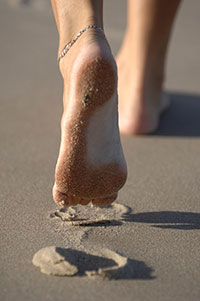
    Consider changing your footwear as part of your fall-prevention plan. High heels, floppy slippers and shoes with slick soles can make you slip, stumble and fall. So can walking in your stocking feet. Instead:

    • Have your feet measured each time you buy shoes, since foot size can change.
    • Buy properly fitting, sturdy shoes with nonskid soles.
    • Avoid shoes with extra-thick soles.
    • Choose lace-up shoes instead of slip-ons, and keep the laces tied. If you have trouble tying laces, select footwear with fabric fasteners.
    • If you’re a woman who can’t find wide enough shoes, try men’s shoes.

    4. Remove home hazards

    Take a look around your home. Your living room, kitchen, bedroom, bathroom, hallways and stairways may be filled with hazards. To make your home safer:

    • Remove boxes, newspapers, electrical cords and phone cords from walkways.
    • Move coffee tables, magazine racks and plant stands from high-traffic areas.
    • Secure loose rugs with double-faced tape, tacks or a slip-resistant backing — or remove loose rugs from your home.
    • Repair loose, wooden floorboards and carpeting right away.
    • Store clothing, dishes, food and other necessities within easy reach.
    • Immediately clean spilled liquids, grease or food.
    • Use nonskid floor wax.
    • Use nonslip mats in your bathtub or shower.

    5. Light up your living space

    Keep your home brightly lit to avoid tripping on objects that are hard to see. Also:

    • Place night lights in your bedroom, bathroom and hallways.
    • Place a lamp within reach of your bed for middle-of-the-night needs.
    • Make clear paths to light switches that aren’t near room entrances. Consider trading traditional switches for glow-in-the-dark or illuminated switches.
    • Turn on the lights before going up or down stairs.
    • Store flashlights in easy-to-find places in case of power outages.

    6. Use assistive devices

    Your doctor might recommend using a cane or walker to keep you steady. Other assistive devices can help,

    too. For example:

    • Hand rails for both sides of stairways
    • Nonslip treads for bare-wood steps
    • A raised toilet seat or one with armrests
    • Grab bars for the shower or tub
    • A sturdy plastic seat for the shower or tub — plus a hand-held shower nozzle for bathing while sitting down

    If necessary, ask your doctor for a referral to an occupational therapist. He or she can help you brainstorm other fall-prevention strategies. Some solutions are easily installed and relatively inexpensive. Others may require professional help or a larger investment. If you’re concerned about the cost, remember that an investment in fall prevention is an investment in your independence.

    holding_cane

    I serve the counties of El Dorado, Placer, Sacramento, Solano, Sutter, Yolo, and Yuba, cities like Auburn, Lincoln, Rocklin, Roseville, Sacramento, Placerville, and Woodland.

    Tags: , , , , , , , , , , , , ,

  • November 18, 2013 /  Dementia

    I ran across an article from BBC news on a study that there is initial evidence that autism may be detected in babies as soon as their second month. It looks like more study needs to be done but the initial study lays the ground work of hope for future studies. I’ve included the link to the article below.

    http://www.bbc.co.uk/news/health-24837462?goback=%2Egde_1905451_member_5804455875665997827#%21

    Early-Detection

    I serve the counties of El Dorado, Placer, Sacramento, Solano, Sutter, Yolo, and Yuba and cities like Auburn, Lincoln, Rocklin, Roseville, Sacramento, Placerville, and Woodland.

    Tags: , , , , , , , , , , , ,

  • November 11, 2013 /  Resources

    I have written on this before. In order to take care of others, you need to take care of yourself. It’s similar to the instructions you receive in the cabin of an airline, “Put the oxygen mask over your mouth and nose first, THEN put it over the mouth and nose of your child.” In other words, save yourself first, then the other person.

    This link offers a thorough assessment and analysis of caregiver burnout. Enjoy.

    https://www.helpguide.org/articles/stress/caregiver-stress-and-burnout.htm

    caregiver holding hand

    Tags: , , , , , , , , , , , , , ,

  • November 4, 2013 /  Basics

    One of the more wonderful but sometimes difficult things I do in my profession is to visit my clients. My appearance is not always welcomed as many of my clients would rather manage the funds in my control than to have me do it but as we settle in I begin to show them how I can help and protect them in their lives as an advocate. That is where the wonderful part comes in, I get to help them improve their lives once they are willing to accept the help.

    I say all this to bring home a point: being a trustee, conservator or guardian is not only a great way to help your community one person at a time but also brings with it great responsibility for the one who acts in this capacity and also the one who sets the trust up.

    I came across this article from a newsletter that Kevin Urbatsch of Meyers Urbatsch P.C.  sends out from the Academy of Special Needs Planners that emphasizes this dual need. Kevin is an attorney that specializes in setting up Special Needs Trusts and helping Trustees administer them.  This is the link to the newsletter. The link to the article is at the end of their article.

    http://www.specialneedsanswers.com/resources/article.asp?id=19901&section=4

    I have thought that making it mandatory to visit the beneficiary at least once a month would be a good thing to add to the trust (California requires all conservators to visit their charges at least once a month). In some cases a trust protector could serve in the oversight role (but like everything else, it too can be corrupted).

    guardian visit 


    I serve the counties of El Dorado, Placer, Sacramento, Solano, Sutter, Yolo, and Yuba, cities like Auburn, Lincoln, Rocklin, Roseville, Sacramento, Placerville, and Woodland, and Meyers Urbatsch P.C. and the Academy of Special Needs Planners.

    Tags: , , , , , , , , , , , , ,

  • October 3, 2013 /  Special Needs

    Here is an article from Ken Covinsky on Kevinmd.com.

    smiling nurse I too, have found that not only are the nurses and doctors in an assisted living and skilled nursing have a lack of concise or correct information to the recent care of their patient in a hospital but also the patient’s primary care doctor (PCD) lacks the same information! Each time I have had my client come back to their respective communities, I have had to readdress the medications given them with their PCD as well.

    In advocating on my client’s behalf, I request the attending physician in the skilled nursing community work with my client’s PCD. The PCD usually does not want to “interfere” with the skilled nursing doctor but, as far as I am concerned, the PCD are the ones who know my client’s medical history the best and are most likely to better understand their needs.

    Serving Auburn, Lincoln, Roseville, Rocklin, Sacramento, and the counties of Placer, Sacramento, Sutter, Yolo, Yuba, El Dorado, Nevada and even Humboldt.

    Tags: , , , , , , , , , , , , , , , , ,

  • August 29, 2013 /  Special Needs

    I had a blind guitar instructor in college. He knew his way around campus (Sac State) and was more than proficient playing the guitar. He didn’t need help, taught me the right way to “guide” him (he held on to my arm) when he needed help in negotiating or was lazy in using his stick, and amazed me with his independence.

    One day he was teaching me a fancy lick on the guitar and all of a sudden he “disappeared”. I mean, not physically but mentally…personality left. He was quite for a few moments and then asked, “Where am I, who are you?” I asked him if he was okay and he started getting agitated so I told him my name and that we were in his house. He asked what was going on and why he couldn’t see anything. At that moment I remembered that sometimes when someone “blanks” out that it could be a form of epilepsy.

    the arc logoI don’t know why I should think of that right then but I decided to “play along” with him. I told him that the lights went out, we were waiting for them to come back on and that, in the meantime, I was playing guitar for him. So I asked if I could continue and he was okay with that.

    When he “came back” he again, asked what happened. This time I used his name and asked him, “Is that you?” Answering in the affirmative he asked if I understood what just happened. I told him that I guessed that he had an epileptic episode and he confirmed it. He was pleasantly surprised that I would know that and apologetic that he hadn’t told me that he had seizures in the past but hadn’t had any for a couple of years. He was the best guitar instructor I ever had and miss him and his corny jokes.

    The point is that I was prepared and that is one of the messages of The Arc organization. They want the public to understand and be prepared for including those with intellectual and developmental disabilities into their world. They also advocate on their behalf and provide resources.

    Please visit the national website http://www.thearc.org/who-we-are and then go to the state site http://www.thearcca.org/ and finally our local site in Roseville http://www.thearc.org/.

    Serving Auburn, Lincoln, Roseville, Rocklin, Sacramento, and the counties of Placer, Sacramento, Sutter, Yolo, Yuba, El Dorado, Nevada and even Humboldt.

    Tags: , , , , , , , , , , , , , , , , , ,

  • August 27, 2013 /  Miscelleaneous

    Social Security Benefits for Same-Sex CouplesSocial Security is now processing some retirement spouse claims for same sex couples and paying benefits where they are due. See: http://ssa.gov/pressoffice/pr/doma-statement-pr.html and http://ssa-custhelp.ssa.gov/app/answers/detail/a_id/2488/related/1.

    I serve the counties of Placer, Sacramento, Sutter, Yolo, Yuba, El Dorado, Nevada, and even Humboldt.

    Tags: , , , , , , , , , , ,

  • August 20, 2013 /  End of Life Issues

    Man and woman planningI was reading Ashlea Ebeling, a Forbes staff writer, the other day by way of a suggestion from Elise Baker, an attorney in Rocklin Ca., on the topic of Payable On Death (POD) accounts.

    POD accounts are set up so that when the owner dies the funds automatically go to the beneficiary (hence; Payable on death). The beneficiary is not able to access the funds while the owner is alive (with or without capacity) and it avoids probate. They can be a great estate planning tool but…

    Like everything, this tool needs to be carefully used. Ashlea shared a couple of scenarios where it was the wrong tools are not used correctly. If you have a question about this please contact your estate planning attorney, they may help make settling your estate go smoother…which is what I do on your behalf.

    I serve Placer, Sacramento, Yolo, Yuba, Sutter, El Dorado, Solano and even Humboldt counties and your first consultation is free.

    Tags: , , , , , , , , ,

  • July 19, 2013 /  Basics

    walk to end alzheimer'sDementia is a reorganization of the brain resulting memory loss, hallucinations, and general breakdown of bodily functions. Alzheimer’s disease is one specific subset of dementia. The Alzeimer’s organization (www.alz.org) reported July 17, 2013 that those who notice memory loss or issues with decreasing ability toward organization may actually be sensing the onslaught of dementia far in advance of what any test would show.

    Visit www.alz.org for more information. There are some articles from papers around the country reporting the study.

    If you live in the Sacramento area their fundraiser “Walk to End Alzheimer’s” will take place October 5, 2013 at the State Capitol (South Steps) at 8:00am. Contact: Sacramento Walk to End Alzheimer’s 31915 Rancho California Road #200-438 Temecula, CA 92591

    In the Yuba City area the Walk takes place September 21, 2013 at the Feather River Parkway 8:00A.M. Contact Ericka Smith Phone: 650.962.8111 Email: esmith1@alz.org

    I currently serve clients in the counties of Placer, Sacramento, Yolo, Yuba, El Dorado, Solano and Humboldt. Depending on the situation, I can serve clients in other counties as well.

    Please call 916-220-3474 for your first hour free consultation.

    Tags: , , , , , , , ,

  • July 12, 2013 /  Basics

    fiduciaryAccording to Wikipedia, “A fiduciary is a legal or ethical relationship of trust between two or more parties. Typically, a fiduciary prudently takes care of money for another person. One party, for example a corporate trust company or the trust department of a bank, acts in a fiduciary capacity to the other one, who for example has funds entrusted to it for investment. In a fiduciary relationship, one person, in a position of vulnerability, justifiably vests confidence, good faith, reliance and trust in another whose aid, advice or protection is sought in some matter. In such a relation good conscience requires the fiduciary to act at all times for the sole benefit and interest of the one who trusts.” https://en.wikipedia.org/wiki/Fiduciary, July 12, 2013

    Again, according to the Professional Fiduciary Association of California (PFAC), “A fiduciary as trustee has the responsibility of carrying out the terms of a testamentary or living trust. The trustee is usually a person named by the creator of the trust, but in some cases, the trustees cannot carry out his or her duties because of incapacity or death. If there is no successor trustee who can serve, the court has the responsibility of appointing a trustee, usually someone nominated by the trust beneficiary who then safeguards the assets and invests them according to the Uniform Prudent Investor’s Act (as set forth in the Probate Code). Professional trustees working under the UPIA are held to a higher standard than others. The fiduciary as conservator is the person who is legally appointed to manage the conservatee’s estate and/or person. A conservatorship is a legal tool designed to provide management for the financial and/or personal affairs of individuals deemed by the court to be physically or mentally incapacitated, often because of dementia.” http://www.pfac-pro.org/ohana/website/index.cfm?p=118001 July12, 2013

    In order to be a member of PFAC, professionals must be licensed, agree to adhere to the code of ethics, and demonstrate a commitment to their own professional skills by completing continuing education units annually.

    Licensing is processed and monitored through the Department of Consumer Affairs; Professional Fiduciary Bureau (http://www.fiduciary.ca.gov/). My number is #387.

    Trustees manage money, and oftentimes, difficult people and situations. When money is involved, beneficiaries and trustees sometimes have disagreements, and family arguments can be among the most rancorous. There are plenty of traditional families, blended families, dysfunctional families that are faced with an abundance of problems and issues when a parent dies or becomes incapacitated and there is money in an estate to be protected and invested. Sometimes non-professional trustees mismanage or neglect their trustee duties, and sometimes he or she may ignore the directions of the trust. Beneficiaries get angry, get an attorney and go to the probate court for resolution. That resolution often names a private professional fiduciary as the new trustee. Many attorneys, accountants and estate planners, who know good private professional fiduciaries, sometimes suggest a professional be named as trustee when a new trust is written.

    I currently serve clients in the counties of Placer, Sacramento, Yolo, Yuba, El Dorado, Solano and Humboldt. Depending on the situation, I can serve clients in other counties as well.

    Please call 916-220-3474 for your first hour free consultation.

    Tags: , , , , , , , , , , , ,